
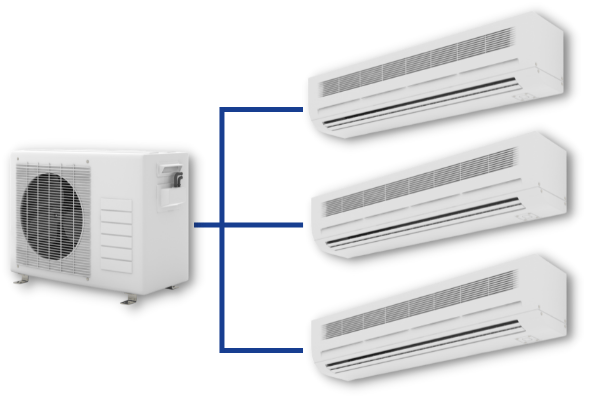
In a flat in Valencia, the outdoor air conditioning unit can usually go in the light well, on your own gallery or terrace, or on the building’s roof. The street-facing façade is the most restricted option. In any case, you need to check two different permissions: the residents’ association’s and the municipal regulations, which are stricter for listed buildings and in areas such as Ciutat Vella.
We explain what to check, which locations cause the fewest problems and how to install the unit without complaints from neighbours or notices from the City Council.
Residents’ association permission to put air conditioning on the façade or in the light well
The façade is a common element of the building. The Spanish Horizontal Property Act does not allow an owner to alter common elements on their own, and the courts have treated each case differently: a unit on the main façade is not the same as one in an inner courtyard where there are already others.
In practice, what almost always decides it is what is already written down in your residents’ association. That is why, before asking for a quote, it is worth making these checks:
- Check the bylaws and the minutes: many residents’ associations have already agreed where units can go.
- If nothing has been agreed, the sensible thing is to raise it at the residents’ meeting before installing.
- If there are already units in the light well, it is usually the easiest location to get accepted.
How to raise it with the property manager without losing months
Go to the residents’ meeting with a finished proposal: where the unit would go, where the pipework runs and where the drain goes. A few photos of the spot help neighbours see that it will not be noticeable. If your installer gives you these details in writing after the visit, it is easier for the property manager to put it on the agenda.
What València City Council says about units on façades
Where an outdoor unit can go is set by each municipality’s bylaws and urban planning rules. In València, the aim is for units not to be visible from the street: they are usually placed on roofs, terraces or inner courtyards, and in listed buildings or in the historic centre the conditions are stricter. Before installing on a street-facing façade, it is worth checking with the City Council or asking your installer to look into it.

Ciutat Vella, El Cabanyal and listed buildings
In neighbourhoods such as El Carme, La Seu, El Mercat or Velluters, and in the tiled-façade houses of El Cabanyal, the street-facing façade is not normally an option. There, the work is done on the roof, the inner courtyard or the back of the property.
Dripping and noise: the most common complaints
There are two things that are often penalised in any city: the unit dripping onto the street and the unit making more noise than permitted, especially at night. In Valencia, with the summer humidity, the unit produces quite a lot of water, and a constant drip onto the pavement or the balcony below is noticed straight away. And on July nights, with every window open, any hum reaches the neighbour’s bedroom.
Where to put the outdoor air conditioning unit in a flat in Valencia
This table sums up the options we see on our visits:
| Location | Advantages | Things to bear in mind |
|---|---|---|
| Light well | Not visible from the street and usually accepted by the residents’ association | Noise towards neighbours and ventilation of the light well |
| Your own gallery or terrace | Easy access for maintenance | Make sure it is not boxed in: it needs air to perform well |
| Building roof | No visual impact and no noise near windows | Longer pipework and permission from the residents’ association to use the roof |
| Street-facing façade | Sometimes the only technical option | The most restricted: check first |
Buildings with a light well and gallery
In many 1960s and 1970s buildings in neighbourhoods such as Patraix, Benimaclet, Campanar or Russafa, the gallery or drying area overlooking the inner courtyard is the most practical spot. What you need to watch is that the unit is not tucked into an enclosed recess with a blind or glass: if the hot air cannot get out, the unit draws it back in, performs worse and is under strain right in August.
The roof, when the flat has no other outlet
If your home only faces the street, the roof is usually the alternative. The pipework runs up through a service shaft or the light well, and you need permission from the residents’ association to use that common space. It involves more work, but it leaves the façade untouched.

How to install the air conditioning unit without problems with the neighbours
Most complaints come not from the location chosen, but from how it has been installed. These are the five points we check on every installation:
- Condensate drain piped to a downpipe, never dripping into the light well or onto the street. If there is no downpipe nearby, a condensate pump is fitted.
- Anti-vibration mounts so that noise is not transmitted to the wall. Without them, the neighbour next door hears the compressor start up even if the unit is on your gallery.
- Quiet unit: compare the decibels of the outdoor unit when choosing.
- Distance from the windows of other neighbours, especially bedrooms.
- Access for maintenance: if nobody can reach the unit, nobody will clean it.
Common mistakes we see in Valencia
- Units hung on the outside of the balcony railing, impossible to service without a crane.
- Units shut inside a gallery cupboard with no grille, which trip on high pressure in summer.
- Installations near the sea, in Malvarrosa or Natzaret, without considering the salt air that attacks the outdoor coil.
If there is no room for the outdoor unit: alternatives in listed buildings
If there is nowhere suitable in your building for an outdoor unit, there are systems without an outdoor unit that only need two holes in the wall. They are less powerful, but they can be the solution in listed buildings.
Before giving up, it is worth having a technician look at the whole building. Sometimes there is a service shaft, a storage room on the roof or a back courtyard that cannot be seen from inside the flat. In other cases, a ducted air conditioning system with a single well-hidden unit serves the whole home and leaves the façade as it was. What you should not do is buy the unit first and look for the spot afterwards: if the building is listed, the space available decides which system you can install.
Step by step before installing air conditioning in your flat in Valencia
If you do it in this order, you avoid most of the headaches:
- Read the bylaws and the latest minutes of the residents’ association.
- Book a technical visit to see which locations are possible in your building.
- With the proposal in writing, inform the property manager or take it to the residents’ meeting.
- If the unit will be visible from the street or the building is listed, check with the City Council.
- Choose the unit to suit the location: output, outdoor unit noise and size.
- Install with a piped drain, anti-vibration mounts and access for maintenance.
The step most often skipped is the second one, and it is the one that saves the most time. During the visit, the technician measures the distance to the outdoor unit, looks at where the drain can run down and checks whether the unit will have enough air.
Frequently asked questions
Do I need permission from the residents’ association to put the air conditioning in the light well?
It depends on the bylaws and what has been agreed at the residents’ meeting. If there are already other units in the light well, it is usually simpler, but the sensible thing is to let them know before installing.
Can I be forced to remove the unit from the façade?
Yes. Both the residents’ association and the City Council can require it to be removed if it breaches the bylaws or municipal regulations. That is why it is worth checking before installing.
What should I do if the unit drips onto the street?
The drain needs to be piped to a downpipe or a condensate pump installed. It is a simple fix and avoids penalties and complaints.
Can I put the unit on the balcony of a flat in Ciutat Vella?
If the balcony faces the street, probably not, especially in listed buildings. The usual approach in the historic centre is to look for the roof, the inner courtyard or the back of the building, and check with the City Council first.
How does salt air affect the unit if I live near the beach in Valencia?
In Malvarrosa, El Cabanyal or Natzaret, salt air corrodes the outdoor unit’s coil sooner. It is best to choose a sheltered spot, clean it more often and ask about models with anti-corrosion treatment.
We help you choose the best location for your air conditioning in Valencia
Before installing, we visit your home, look at the options your building offers and suggest the one that causes the fewest problems. After the visit, we give you a fixed quote in writing, and the building or plasterboard work is done by our own team, with no subcontracting. The quote includes the unit, materials, labour, commissioning and a 3-year guarantee.
We have more than 20 years’ experience in air conditioning and are an official service centre for Daikin, Mitsubishi Electric, Panasonic, Fujitsu, Hitachi, Bosch, Midea and LG. More information at air conditioning in Valencia and in Davofrío Valencia.
Thinking about ducted air conditioning? See how much ducted air conditioning costs in a flat in Valencia.
Air conditioning installation in Valencia: where to find us
Davofrío Valencia · Av. de les Corts Valencianes, 58, 46035 València
Phone: 960 00 20 33
Opening hours: Monday 9:00 to 16:00; Tuesday to Thursday 9:00 to 14:00 and 16:00 to 18:00; Friday 9:00 to 18:00
Areas we cover: Campanar, Benicalap, Benimaclet, Russafa, el Cabanyal, Burjassot and the metropolitan area.
Full details of the branch on Davofrío Valencia.




 Spanish
 English
 French