

The air conditioning of a cleanroom has to maintain four parameters at once: air cleanliness, pressure, temperature and humidity, and do so in a stable, documented way. If any of them goes out of range, the batch can be quarantined even if the machines have worked properly.
In the Foia de Castalla, where plastic parts, packaging and components for demanding sectors are manufactured, more and more plants need controlled production areas. Much of this industry grew out of the toy-making tradition of Ibi and Onil, and today it works for customers who require audits and records. This is how we design and maintain these rooms from our Ibi branch.
What cleanroom air conditioning controls
A cleanroom is not an industrial building with filtered air. It is an enclosed space where the air conditioning system determines how many particles are in the air, which way that air moves and the conditions the product is exposed to. These are the four areas:
| Parameter | How it is achieved |
|---|---|
| Particle concentration | Multi-stage filtration with terminal HEPA filters and a number of air changes per hour suited to the class. |
| Differential pressure | Stepped overpressure relative to corridors and outside areas, so that dirty air does not get in. |
| Temperature | Air handling unit with cooling and heating coils and precise control. |
| Relative humidity | Dehumidification and humidification according to the process and the product. |
Why pressure is the most closely monitored parameter
Overpressure is the room’s invisible barrier. Every time someone opens a door or a trolley comes in, the air has to flow outwards and not the other way round. If the filters gradually clog and nobody corrects it, the air flow drops, the pressure falls and dust from the building starts getting in without being visible to the naked eye.
How to choose the ISO class of a cleanroom for industry in Ibi
The cleanliness class each room needs (under ISO 14644-1) depends on the product and the end customer, and it determines the design of everything else. Injection moulding a technical housing is not the same as making packaging that will be in contact with food or a component for healthcare use.
The more demanding the class, the more air changes, filter area and energy are needed. That is why it is best not to oversize: asking for a stricter class than necessary makes the installation and its lifetime energy use more expensive. Nor should you fall short, because a room that does not reach the agreed class will fail the customer’s audit.
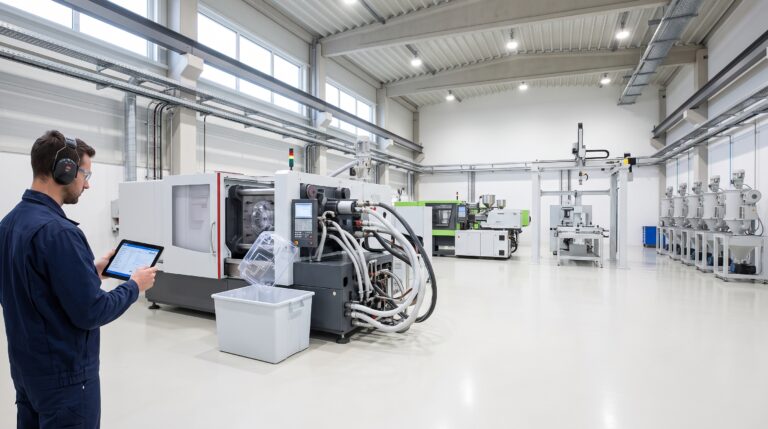
We make the decision with you and your quality manager, based on what your customer requires in writing, not on “what is usually done”.
The stages of a cleanroom project, step by step
A well-run project always follows the same order. Skipping a stage, especially the first, is the most common reason rooms have to be redone.
- Defining the requirements with the quality manager: ISO class, temperature and humidity ranges, heat loads from machines and people.
- Designing the installation: air handling unit, ductwork, air distribution with terminal filters and returns.
- Installation and commissioning, with balancing of air flows and pressures.
- Validation: measurements of particles, air flows and pressures to document that the room complies.
- Maintenance and periodic requalification.
The typical mistakes keep recurring: calculating the heat load without counting the injection moulding machines that will be added later, placing the returns where they are least in the way instead of where they sweep the room best, or starting production before the air flows are balanced. They can all be avoided on paper, and on site they are expensive.
Cleanrooms with plastic injection moulding in Ibi: air conditioning and process cooling
In a room with injection moulding machines, the heat they generate is enormous. The room’s air conditioning has to work together with the process cooling that cools the moulds, normally with chillers. Designing them separately leads to rooms that cannot hold their temperature or to soaring energy use. That is why we study both systems together.
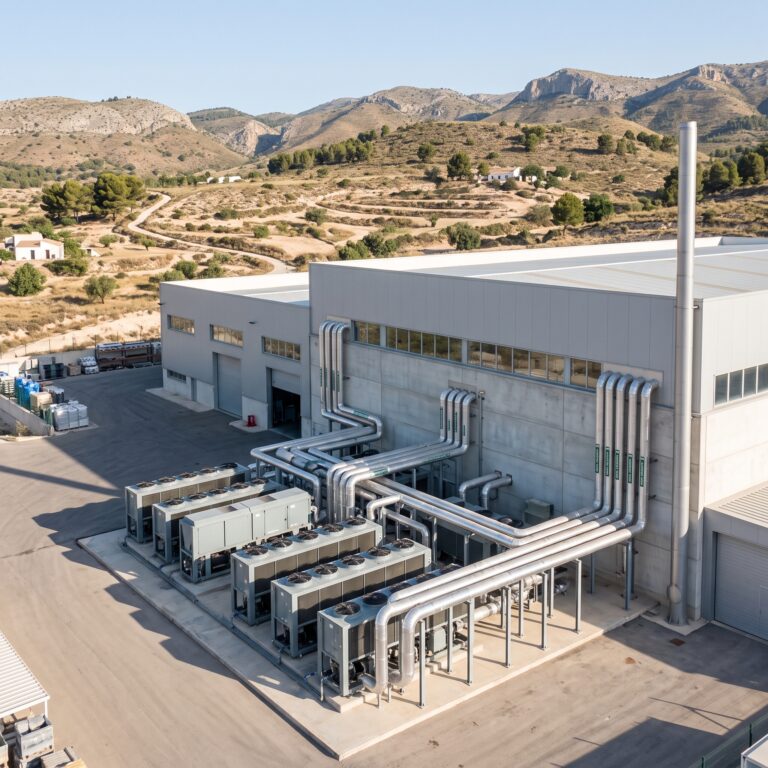
In practice, it is a matter of deciding how much of the heat is removed by the water circuit and how much has to be absorbed by the room air. In summer, with the buildings on the industrial estates of Ibi and Castalla in full sun, that difference shows in the bill and in how stable the temperature is next to the machines. If you already have chillers, the first step is to check whether they have spare capacity for the new room before considering new equipment.
Validation and records for your customers’ audits
A cleanroom is not worth what the design says, but what the measurements prove. During validation, particles are counted at the defined points, air flows are measured at the terminal filters and the pressures between each zone and the next are checked. Everything is recorded in writing, with the date and the measuring equipment.
These are the documents you will show when your customer comes to audit the plant. That is why we prepare them with their reader in mind: what was measured, where, with what result and against which requirement. We work with an ISO 9001:2015 quality management system, which requires every intervention to be documented.
Cleanroom maintenance: what ensures the room remains compliant
A validated room gradually stops complying if nobody monitors it. Filters clog, door and panel seals wear and fans lose performance. Maintenance is there to detect it before your customer does.
- Monitoring the pressure drop across the filters and planned replacement.
- Regular checks of differential pressures and air flows.
- Inspection of the air handling unit: coils, fans, humidification.
- Records for your customers’ audits.
- Rapid response: a room out of specification can halt production.
Mistakes we see in maintenance
The most common is changing filters only when they look dirty, instead of following the pressure drop shown on the differential pressure gauge. Another is replacing a HEPA filter without then checking its seal and air flow, or failing to record an intervention: if it is not written down, in the audit it is as if it had never been done.
Frequently asked questions
Can part of an existing industrial building be converted into a cleanroom?
Yes. It is common to build the room inside the industrial building with panels and give it its own air handling unit. The first step is to see how much space there is above for ductwork and where the unit can go.
Which ISO class do I need?
It depends on the product and on what your customer requires. We define it with you and your quality department before designing, based on the requirements you have in writing.
Do you maintain cleanrooms you did not install?
Yes. We inspect the existing installation, document its condition and propose a maintenance plan. If documentation from the original validation is missing, we tell you so you know your starting point.
What is the difference between a cleanroom and an area with filtered air?
An area with filtered air improves cleanliness but does not guarantee a specific class. A cleanroom also controls pressure, temperature and humidity, and is validated with documented measurements.
Do you serve plants in Castalla, Onil or Alcoi?
Yes. From our Ibi branch we serve industry across the whole Foia de Castalla, including Castalla, Onil and Tibi, as well as Alcoi.
Industrial air conditioning engineering in Ibi
We serve industry in Ibi, Castalla, Onil, Tibi and Alcoi, with our own technicians and an ISO 9001:2015 quality management system. See also our services for industrial refrigeration and chillers, or contact Davofrío Ibi.
If you are thinking of setting up a cleanroom or you have one that causes problems in audits, tell us what you manufacture and what your customer requires. After the technical visit we send you a fixed written quote, with the scope of each stage.
Everything we do for businesses in the area (chillers, industrial refrigeration, plastic injection moulding and cleanrooms) is on air conditioning and industrial refrigeration in Ibi.
Industrial air conditioning in Ibi: where to find us
Davofrío Ibi · C/ Madrid, 18, 03440 Ibi (Alicante)
Phone: 965 05 12 35
Opening hours: Monday to Friday, 8:00 to 18:00
Areas we cover: the industrial estates of Ibi, Castalla, Onil, Tibi, Alcoi and the whole Foia de Castalla.
Full details of the branch on Davofrío Ibi.



 Spanish
 English
 French