
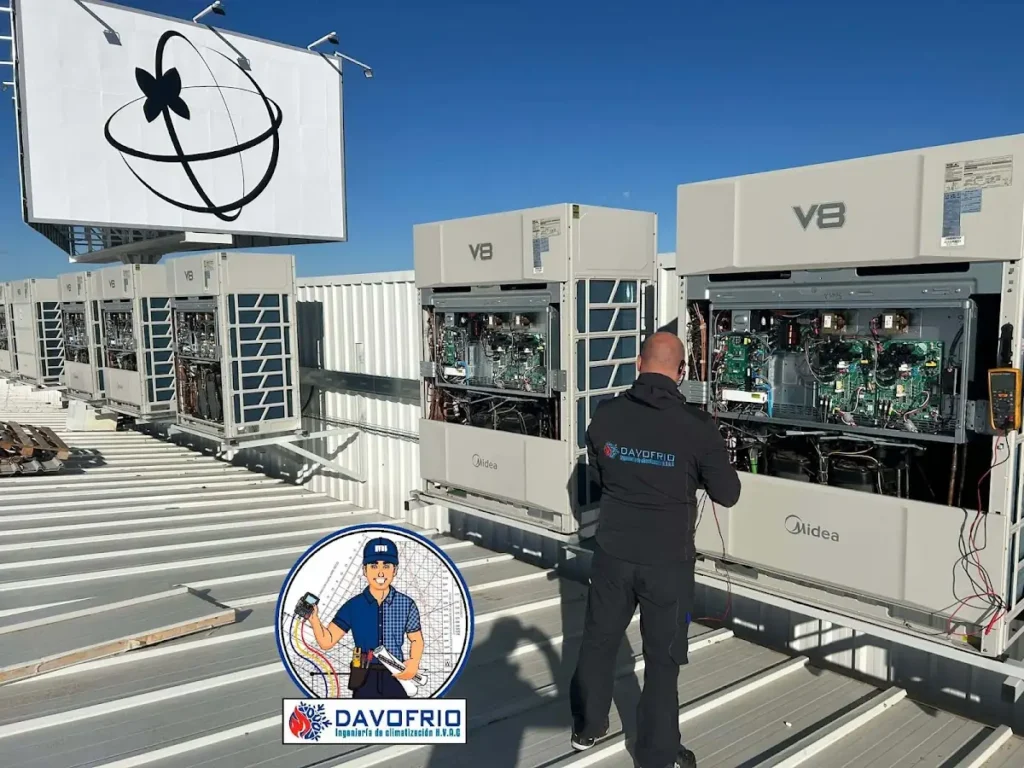
To air-condition an industrial unit in Alicante, you have to start by knowing what you want to control: the heat your staff are putting up with, the temperature of a process or that of the goods. Depending on the answer, the system changes completely: direct expansion, a chiller with a water circuit, evaporative cooling or properly calculated ventilation, and very often a combination.
Choosing the equipment before asking that question is the most expensive mistake. Let's look at how the decision is made, which system suits each unit, what the cost depends on and the faults we see most often on the industrial estates of l’Alacantí.
What your unit needs before we talk about machines
In industrial air conditioning in Alicante, no two units are ever really the same. A logistics warehouse in Las Atalayas with loading bays open all day has nothing in common with an injection moulding plant in Canastell, in Sant Vicent del Raspeig, running three shifts with machines giving off heat non-stop. Before proposing anything, you need to be clear on the following:
- What the air conditioning is for: people's comfort, process stability or product storage.
- The building: clear height, type of roof (metal sheeting, sandwich panel), insulation and orientation.
- Internal loads: machinery, ovens, compressors, lighting and number of people per shift.
- How much outside air gets in: loading bay doors, doors left open, extraction systems.
- Operating hours: a unit open from 8am to 3pm is not the same as one running 24/7.
With that information, the real heat loads are calculated. That calculation is what determines the capacity and type of system, not a manufacturer's catalogue.
On top of that, staff must work within the temperatures set by Royal Decree 486/1997 on workplaces. In a metal-clad unit in July with no system at all, it is easy to go beyond them.
Systems for air-conditioning an industrial unit in Alicante
There is no best system in the abstract. Each one solves a particular type of unit:
| System | Where it fits | Things to bear in mind |
|---|---|---|
| Direct expansion (VRF/VRV, rooftop) | Offices inside the unit, showrooms, enclosed warehouses | Zone control. The refrigerant pipework layout needs to be calculated carefully. |
| Chiller with a water circuit | Processes (injection moulding, chemicals, food) and large units with several zones | Higher initial investment. Depends heavily on the hydraulic design. |
| Evaporative cooling | Open units or ones with loading bay doors that are never closed | Cools the air at workstations, but does not control humidity. |
| Ventilation and free cooling | Units with heat from machinery, fumes or dust | Uses outside air when it is cooler than the air inside. |
Direct expansion: VRF and rooftop units
VRF/VRV systems suit the part of the unit that works as an office: administration, laboratory, quality control room or showroom. Each zone runs at its own temperature and the compressor does not run at 100% when demand is lower. If the initial calculation was sound, indoor units can be added later without changing the outdoor unit. More detail on our page about VRF and VRV systems.
Open units: evaporative cooling and destratification
In units with loading bays open all day, cooling with a compressor is throwing energy out of the door. There, evaporative cooling usually works better, with fans that move the hot air that builds up under the roof. We cover this in the post on air conditioning for industrial units in Elche, and it applies just as well to a unit in la Vallonga or Elche Parque Empresarial.
Ventilation: the most overlooked part
Many hot units have a ventilation problem rather than a cooling one. Extractor fans fitted without calculation move air, but they don't remove the heat from where it is. With measured airflows and free cooling, outside air is used during the cooler hours and the load on the cooling equipment is reduced. In our industrial ventilation service, we measure airflows and pressures in the unit itself before proposing anything.
Chillers and hydraulic circuits: where efficiency is won or lost
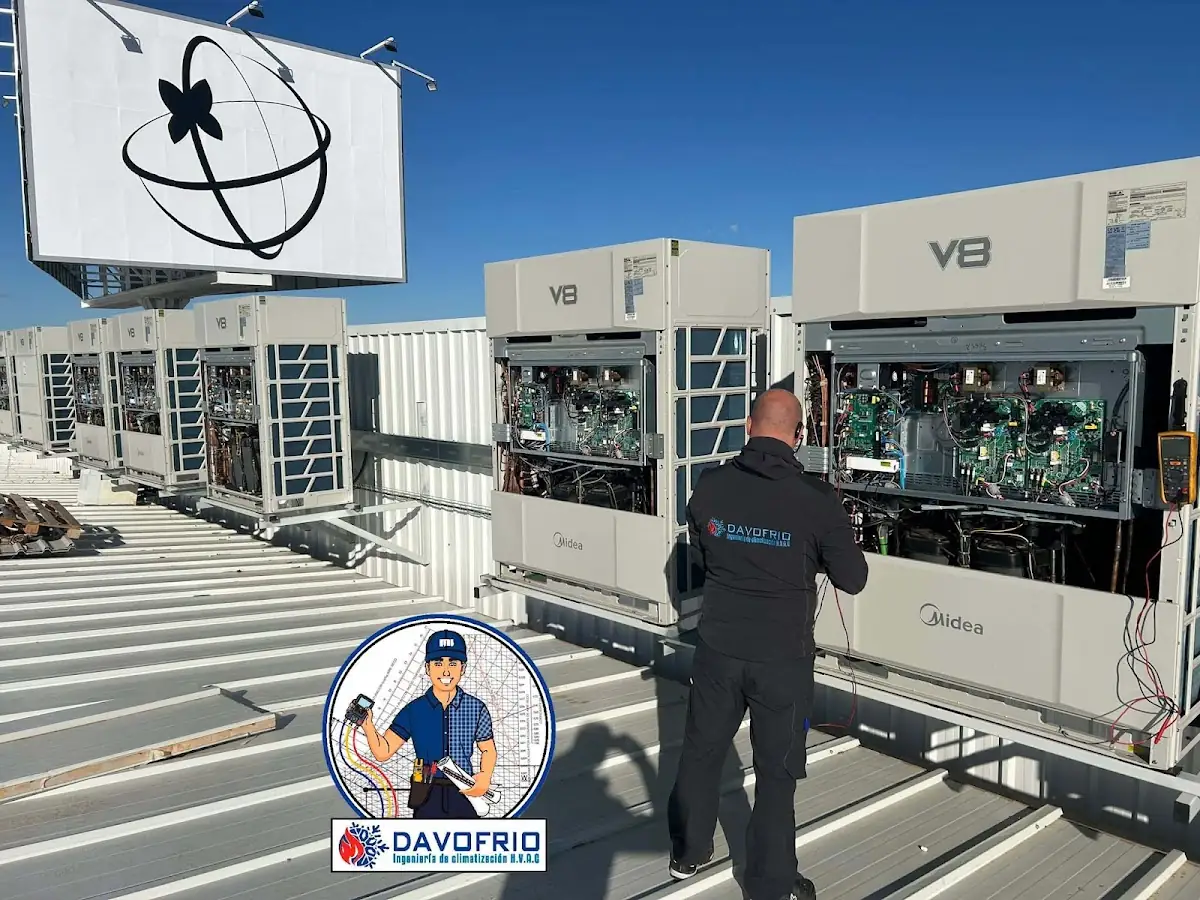
When a building has processes to cool or many zones, the usual solution is a chiller that produces chilled water and distributes it through pipework to air handling units, fan coils or the machines themselves. It is very common in the plastics industry across the province. Here the water circuit matters as much as the machine.
The faults we see most often in poorly designed circuits:
- Unbalanced flow rates: some zones get more water than they need and others never reach temperature, while the pump works flat out all day.
- Short cycling: if the circuit has little thermal inertia, the compressor keeps starting and stopping. It uses more energy and wears out sooner.
- Poorly insulated pipes on the roof or in the false ceiling, which lose cooling before they reach their destination.
These are solved with engineering, not with more capacity. A properly sized buffer tank prevents unnecessary starts. Variable-flow pumps adjust their speed to demand. And pipe diameters calculated section by section reduce pressure losses on long runs.
If you notice zones that don't reach temperature, water noise in the pipes or high pump consumption, the problem is usually in the circuit, and it can often be fixed without replacing the chiller. The heat from the compressors can also be put to use: we explain how in the post on industrial heat recovery in Alicante.
What the cost of air-conditioning a unit in Alicante depends on
There is no price per square metre that works. Two units of the same size can have very different quotes:
| Factor | Why it matters |
|---|---|
| Volume and height | A high-ceilinged unit has a lot of air to treat and tends to trap heat at the top. |
| Roof and insulation | An uninsulated metal roof in summer turns the unit into an oven and sends the required capacity soaring. |
| Heat from machinery | Injection moulding machines, ovens or compressors add heat load for every hour they run. |
| Doors and air changes | The more outside air gets in, the more energy is needed to treat it. |
| Operating hours | In a 24/7 unit, running costs outweigh the investment, and paying for efficiency pays off. |
It is worth comparing two figures: what it costs to install and what it costs each year to keep the system running. In units that operate long hours, the second one matters more.
Costly mistakes in an industrial unit
We see them again and again in units in Alicante, Sant Vicent and Elche:
- Fitting commercial-grade equipment in a unit that runs 24/7. It is not designed for that kind of duty and fails sooner.
- Sizing by eye, by square metre, without accounting for machinery, roof or open doors.
- Cooling an open unit with a compressor, when the cold air escapes through the loading bays.
- Forgetting about ventilation and trying to solve a build-up of heat with cooling.
- Not planning for maintenance. Commercial thermal installations require mandatory inspections under the RITE (Spain's building thermal installations regulations), and equipment with fluorinated gases requires leak checks. We explain this in the mandatory RITE inspections in Alicante.
How we work with industrial units at Davofrío
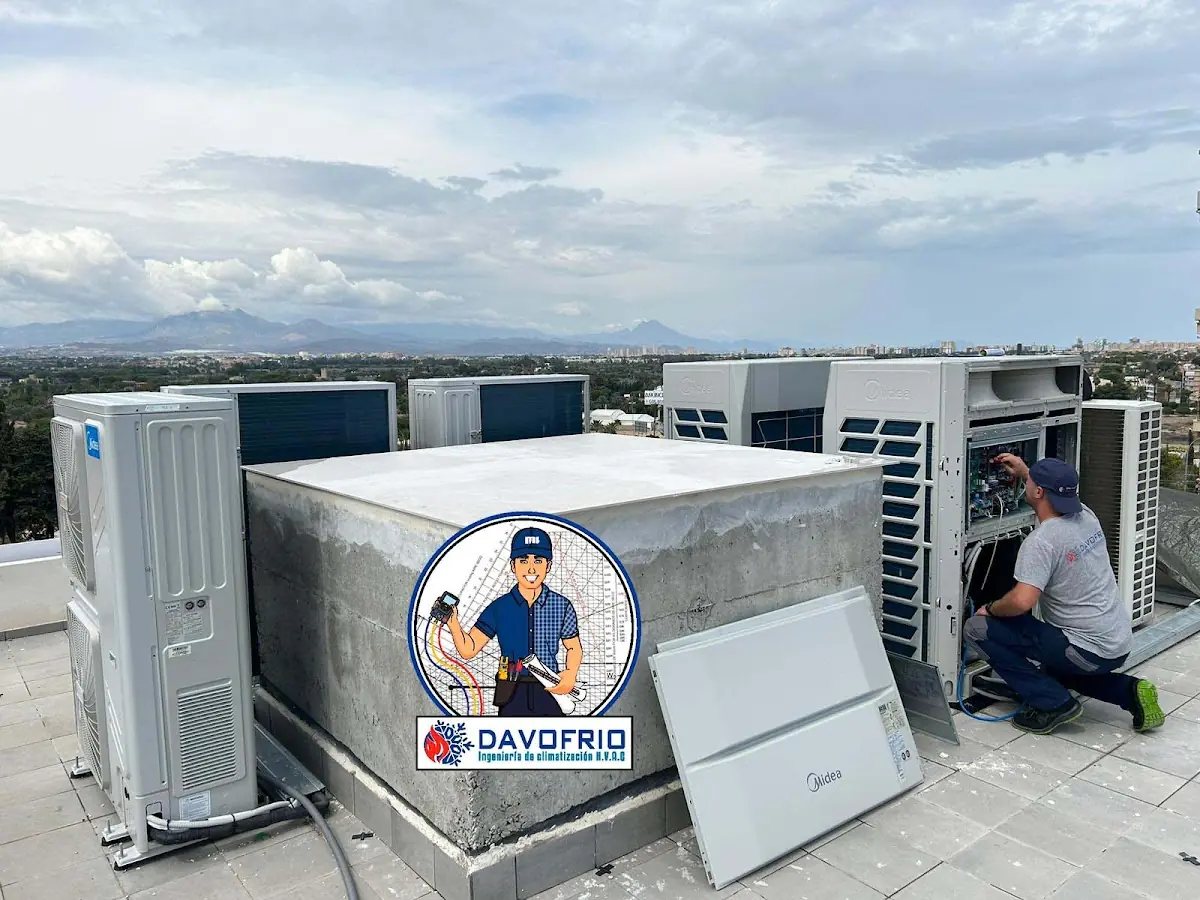
We have been in air conditioning for more than 20 years, since 2003, with our own technicians and installers, no subcontractors, and an ISO 9001:2015 quality system. With industrial units we always follow the same order:
- We listen to the problem: what is happening in the unit, in which zones and at what times.
- Technical visit, with Adrián or the engineering team, to measure airflows and pressures and look at the roof, the doors and the machinery.
- Calculation of real loads before choosing a brand or model. On VRF projects, the signed calculation report comes before anything is approved.
- Report and proposal with the improvement and its estimated payback, and a fixed written quote.
- Installation that disrupts working shifts as little as possible.
After that, preventive maintenance, fluorinated gas leak checks and our own technical service with original spare parts and 24/7 emergency cover for industrial refrigeration. We are the official service agent for brands such as Daikin, Panasonic, Bosch and Hitachi. If your unit has processes to cool, take a look at our industrial refrigeration.
Frequently asked questions about air-conditioning an industrial unit in Alicante
Which system is best for air-conditioning an industrial unit?
It depends on how it is used. Open units are usually best suited to evaporative cooling; offices and enclosed areas to direct expansion; processes or large units with several zones to a chiller with a water circuit. Many units combine two.
How much does it cost to air-condition a unit in Alicante?
There is no reliable price per square metre. It depends on the volume, the roof, the machinery, the open doors, the system and the hours of use. We give a fixed quote after visiting the unit and calculating the loads.
What temperature should there be in a unit where people work?
Royal Decree 486/1997 sets between 17 and 27°C in enclosed premises with sedentary work, such as office work, and between 14 and 25°C for light work. In units that cannot be closed, it requires measures to protect workers as far as possible.
Do you work on the industrial estates in Sant Vicent and Elche?
Yes. From Alicante we serve units in Sant Vicent del Raspeig, such as those in Canastell, on the Alicante industrial estates, such as Las Atalayas or la Vallonga, and in Elche and the rest of the province.
Request a study for your unit in Alicante
Tell us what is happening in your unit: floor area, use, zones and hours. We come to see it, take measurements, calculate the loads and give you a proposal with a fixed written quote. If you already have an installation that is underperforming, we start by reviewing what is there.
Take a look at our industrial refrigeration, ventilation and VRF and VRV systems, or our page on Davofrío Alicante.
Air conditioning for industrial units in Alicante: where we are
Davofrío Alicante · Carrer Garbinet, 28, 03012 Alacant
Phone: 671 69 74 45
Opening hours: Monday to Thursday, 8:00 to 18:00; Friday, 8:00 to 16:00
Areas we cover: Alicante, Sant Vicent del Raspeig, Mutxamel, Sant Joan d'Alacant, El Campello and the whole of l'Alacantí.
Full details of the branch on Davofrío Alicante.




 Spanish
 English
 French