

In Alicante, a pool heat pump is worth it above all if you use the pool often and cover it at night. It lets you swim in warm water from spring until well into autumn, with reasonable electricity costs thanks to the province’s mild climate. The price depends on the volume of water, how much you want to extend the season and what the installation is like.
We explain how it works, what season you can expect, what the quote depends on and how to stop your bill from soaring.
How a pool heat pump works and why it performs so well in Alicante
A heat pump takes heat from the outside air and transfers it to the pool water. For every kWh of electricity it uses, it can deliver several kWh of heat, and the milder the air, the better it performs. That is why it works especially well on the Alicante coast, with its mild springs and autumns.
The water leaves the filter, passes through the heat exchanger, gains a few degrees and returns to the pool. The temperature rises gradually while the filtration system is running, so the two are scheduled together.
The coast versus inland l’Alacantí
Near Playa de San Juan, Cabo de las Huertas or El Campello, the air in spring and autumn is mild for most of the day. In San Vicente del Raspeig or Mutxamel the nights are cooler, and it is best for the unit to run during the middle of the day, when it extracts more heat for the same consumption.
Inverter or on/off unit
An inverter adjusts its output to what the water needs: it starts strongly when the water is cold and slows down as it approaches the set temperature. An on/off unit runs at full power and stops, over and over again. To keep the pool warm for several months, an inverter uses less and makes less noise.
How much a heat pump extends the swimming season in Alicante
Without heating, in most villas in Alicante the water is pleasant from June to September. With a heat pump and a thermal blanket, it is common to swim from April or May until October or November. Heating an outdoor pool all winter is possible, but consumption goes up a lot.
| Pool situation | Usual swimming season |
|---|---|
| Unheated | From June to September |
| With a heat pump and thermal blanket | From April or May until October or November |
| All winter outdoors | Possible, but consumption goes up a lot: it is best to cover or enclose it |
Before asking for a quote, think about when you really use the pool: swimming after school in May is not the same as having it ready at Easter. The earlier or later you want to swim, the more power you need and the more important it becomes to cover the water.
What the price of a pool heat pump depends on
The quote comes down to two things: the power your water needs and the cost of connecting the unit to the filtration circuit. These are the factors that matter most:
| Factor | Why it matters |
|---|---|
| Pool volume | More cubic metres of water need more power. |
| The season you want | Bringing the season forward by a month is not the same as heating the pool all year round. |
| Whether it has a blanket or cover | At night, an uncovered pool loses much of the heat gained during the day. |
| Exposure to wind and shade | Wind cools the water; a pool in the shade needs more heat input. |
| Type of unit | Inverter units adjust their output and use less than on/off units. |
| Installation | Distance to the filtration system, power supply and where the unit goes. |
During the visit, the technician measures the pool, checks whether a pine tree or the neighbour’s house casts shade on it, and checks the distance to the filtration system and the electrical panel. With that, we give you a written fixed quote, which includes the unit, materials, labour, commissioning and a 3-year guarantee.
The most common mistake: choosing the unit from a catalogue
Buying the unit online based on the cubic metres on the spec sheet usually goes wrong. If it is too small, it takes ages to heat the water and runs all day. If it is too big, you pay more without being able to swim any earlier.
How to use less electricity with your pool heat pump: five tips
Most of what a heated pool uses goes on replacing the heat it loses. If you cut those losses, the unit runs for fewer hours. These five habits make the biggest difference to your bill:
- Cover the pool at night with a thermal blanket. It is what saves the most.
- Do not overdo the temperature: 26–28 °C is enough for most people.
- Run the pump during the mildest hours, when it performs best.
- If you have solar panels, schedule the unit to run during the sunny hours.
- Have it serviced every year: a dirty or limescaled heat exchanger loses efficiency.
In areas exposed to the wind, such as the developments on Cabo de las Huertas or the seafront in El Campello, the blanket matters even more. Wind sweeping across the surface of the water carries the heat away very quickly, and a hedge or a screen on the exposed side also helps.
Pool heat pump maintenance: what to check every year in Alicante
A heat pump that is not serviced gradually loses efficiency. The water in much of the province is hard and limescale builds up in the heat exchanger; near the sea, salt air takes its toll on the fins of the outdoor coil. The unit still switches on, but uses more to do the same job.
Ideally, it should be serviced before the season starts. This is what the technician checks:
- Cleaning of the outdoor coil and the fan, without bending the fins.
- Condition of the heat exchanger and the water flow reaching it from the filter.
- Electrical connections, protection devices and compressor consumption.
- Temperature sensors and programming, coordinated with the filtration system.
- Condensate drain, so that no puddle forms next to the unit.
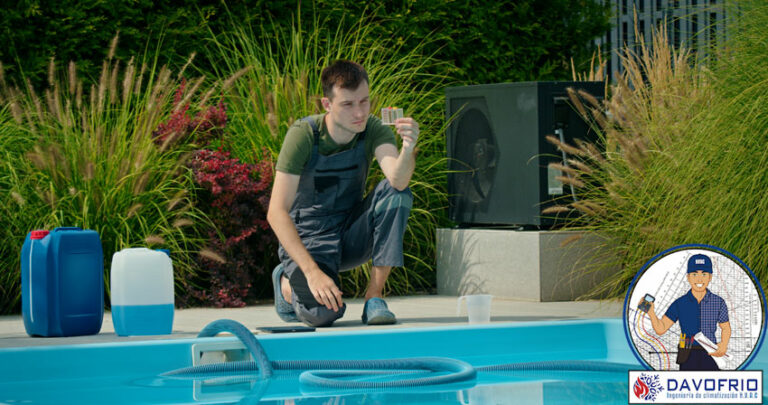
Heat pump or solar thermal panels for your pool
Solar thermal collectors heat the water without using electricity, but they depend on the sun and take up quite a lot of space. A heat pump works in any weather and is easier to control. In many villas in Alicante, combining it with solar PV for self-consumption is the option that costs least to run.
To decide, think about what you have and when you want to swim:
- Solar thermal collectors: if you have plenty of well-oriented roof space and extending the summer a little is enough for you.
- Heat pump: if you want to choose the temperature and swim in spring and autumn even on cloudy days.
- Heat pump with solar PV: if you have panels or plan to install them, the unit runs on the electricity you produce yourself.
Installing a heat pump at a villa in Alicante: location, noise and neighbours
What needs careful thought is where the unit goes. It needs clear air in front of it so it does not recirculate the cold air it expels, and it is best placed near the filtration system to keep the pipe runs short.
In terraced houses and villas on small plots, like those on many developments in Sant Joan d’Alacant or San Vicente del Raspeig, noise is the biggest concern. The rule is simple: away from bedrooms, both yours and your neighbours’, and on a base that does not transmit vibrations. If the pool is communal, the installation has to be approved by the residents’ association, as the Spanish Horizontal Property Act sets out for communal areas.
We serve Alicante, San Vicente del Raspeig, Mutxamel, Sant Joan d’Alacant, El Campello and the whole surrounding area.
Frequently asked questions
How long does it take to heat the pool?
It depends on the volume, the power of the unit and the weather. Bringing it up to temperature the first time can take several days; after that it only has to maintain it, which is much quicker if you cover the pool at night.
Is a pool heat pump noisy?
Modern units are fairly quiet, especially inverter models, which slow down once the water is warm. Even so, it is best to place the unit away from bedrooms and neighbouring houses, and on a base that does not transmit vibrations.
Can it be installed on an existing pool?
Yes. It connects to the filtration circuit, after the filter, with no building work on the pool itself. What you need to plan for is the power supply and a ventilated spot for the unit near the filtration system.
What temperature should the water be?
26–28 °C is enough for most families. Going higher makes little difference when you swim but quite a lot to your bill, because the unit has to replace more heat every night.
We size the heat pump for your pool in Alicante
We have been installing air conditioning and heating in homes and villas for more than 20 years, with our own technicians and no subcontracting. We are an official service centre for brands such as Daikin, Mitsubishi Electric, Panasonic and Fujitsu, so the unit we recommend is one we know how to install, adjust and repair. And if the pool is communal, we prepare a written fixed quote so that the residents’ association can vote with all the facts in front of them.
We visit your pool, work out the power needed for its volume and the season you want, and give you a quote. If you already have a unit, see our pool heating maintenance service, or contact Davofrío Alicante.
Pool heat pumps in Alicante: where to find us
Davofrío Alicante · Carrer Garbinet, 28, 03012 Alacant
Phone: 671 69 74 45
Opening hours: Monday to Thursday, 8:00 to 18:00; Friday, 8:00 to 16:00
Areas we cover: Alicante, Sant Vicent del Raspeig, Mutxamel, Sant Joan d’Alacant, El Campello and the whole of l’Alacantí.
Full details of the branch on Davofrío Alicante.




 Spanish
 English
 French