

To air-condition a clinic, practice or dental centre in Murcia, you need a system that does four things at once: keep each room at its own temperature, renew the air, run quietly and never stop during surgery hours. You achieve this with zoned air conditioning, heat recovery ventilation and maintenance planned before the summer. Here we explain how to approach it and what to check so that a breakdown does not force you to cancel appointments.
What air conditioning requires in a clinic or medical practice in Murcia
A clinic has more constraints than a home: patients waiting seated, professionals working on their feet in gowns and gloves, rooms used at different times and equipment that gives off heat. If the system is not designed for this, the usual complaints appear. The waiting room gets stuffy by mid-morning, the treatment room is cold and the office at the back never reaches the right temperature.
This is what we require of any healthcare installation:
- Indoor air quality: renewal with filtered outdoor air and CO₂ control in waiting rooms.
- Independent zones: the waiting room, treatment rooms, sterilisation room and offices have different loads and schedules.
- Quiet operation: the patient should not hear the unit during the appointment, and the professional should not have to raise their voice.
- No direct draughts on the patient, the treatment couch or the chair.
- Continuity: a breakdown in July can force you to cancel a whole morning of appointments.
In Murcia you also have to factor in the climate. From June to September the system works almost non-stop, and ground-floor commercial premises with lots of glass, common on the avenues in the centre and on Juan Carlos I, heat up a lot in the afternoon. In El Ranero, Espinardo or the outlying districts, many practices are on the ground floor of residential buildings, with little room for the outdoor unit and the residents’ association keeping an eye on noise.
Which air conditioning system suits each type of clinic
What decides it is the number of rooms, whether they are used at the same time, the height of the false ceiling and where the outdoor unit can go. This table sums up what we usually propose:
| Type of centre | Usual solution |
|---|---|
| Small practice (1–3 rooms) | Ducted air conditioning or ceiling split units by zone, with heat recovery ventilation. |
| Dental or physiotherapy clinic | Zoned system with independent control in each treatment room and fresh air renewal. |
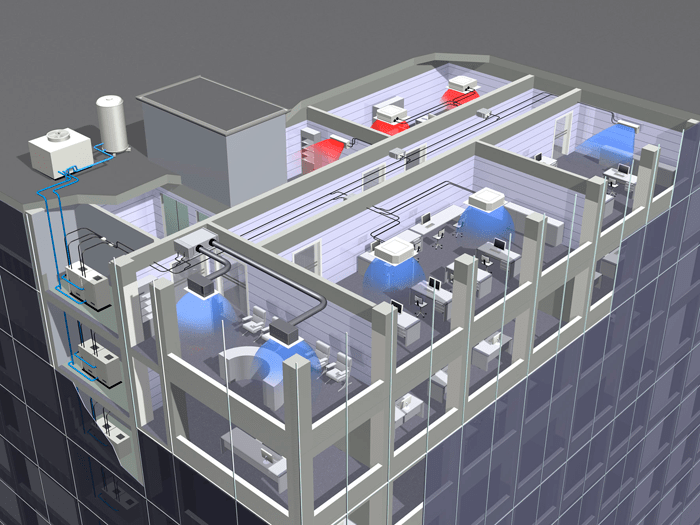
| Clinic on several floors | VRF system with heat recovery and a centralised ventilation unit. |
Small practices and physiotherapy centres
In a practice with two or three rooms, ducted air conditioning through the false ceiling is the most discreet option. If the ceiling does not have enough height, a ceiling split unit or a cassette in each room works well. In physiotherapy, the treatment room should be slightly warmer, because the patient is still and lightly dressed, and that can only be achieved if each zone has its own thermostat.
Dental clinics: control room by room
In a dental centre each treatment room has its own rhythm. The sterilisation room gives off heat all day and needs more cooling than the rest. That is why we propose zones with independent control and diffusers positioned so that the air does not fall on the chair.
Clinics on several floors: VRF with heat recovery
When there are several floors or many rooms, a VRF system with heat recovery lets some zones cool while others heat, taking the surplus heat from one side and moving it to the other. This often happens in spring and autumn: the sunny façade calls for cooling and the inner side calls for heating.
Ventilation in clinics in Murcia: fresh air matters as much as temperature
Air conditioning cools or heats the air already in the room, but it does not renew it. With a full waiting room, CO₂ rises, the air gets stuffy and that heavy-headed feeling sets in. And opening the window in August in Murcia is not an option: in come the heat, the street noise and the dust.
A heat recovery unit brings in filtered outdoor air and makes use of the temperature of the outgoing air, so that ventilating does not send your energy use soaring. In addition, RITE (Spain’s regulation on thermal installations in buildings) sets indoor air quality requirements for healthcare premises. When we design the ventilation for a clinic, the technician looks at the following:
- The maximum occupancy of the waiting room and each treatment room.
- The floor area of the premises and whether it has opening windows.
- Where the supply and extract ducts can run in the false ceiling.
- Where to take in outdoor air and where to expel it, well apart so they do not mix.
- Whether a CO₂ sensor that raises or lowers the airflow according to the number of people would be worthwhile.

Air conditioning maintenance in clinics: what saves you from cancelling appointments
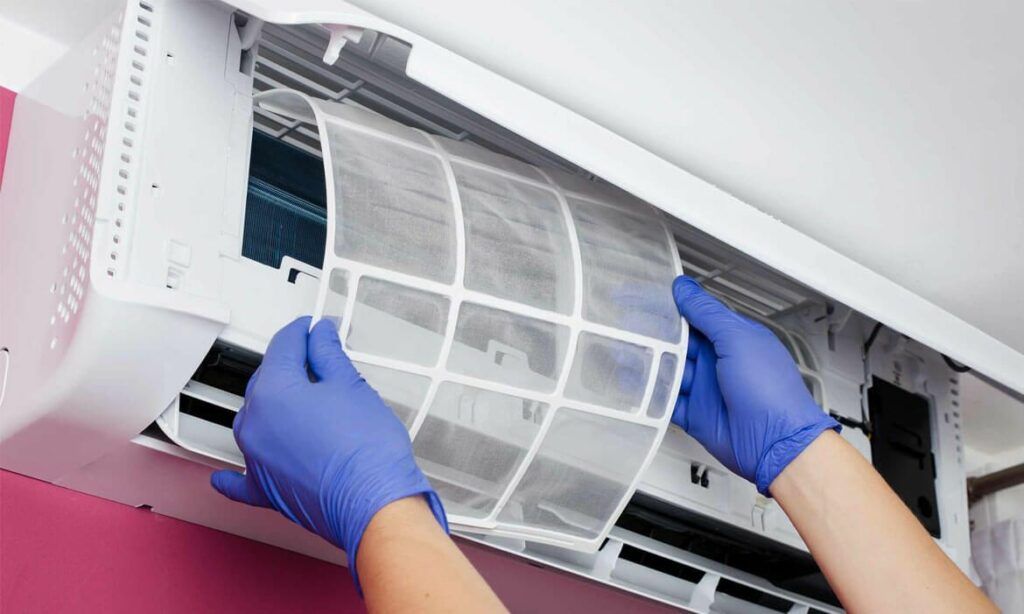
Many summer breakdowns give warning signs first. A clogged filter makes the unit work under strain, a dirty condensate tray ends up dripping onto the ceiling and a dusty coil cools less and less. If this is checked in spring, you reach July with the system in good shape. This is the plan we follow in clinics:
- Filter cleaning and replacement as often as the manufacturer specifies, or sooner if footfall is high. The heat recovery unit’s filters too, which are often forgotten.
- Disinfection of coils and condensate trays, to prevent odours and dirt in the air patients breathe.
- Pre-summer check, when the system works hardest in Murcia: pressures, power consumption, drains and the condition of the outdoor unit.
- Record of operations, useful for health inspections.
- Priority response in the event of a breakdown, so you do not lose the working day.
Common mistakes we see in practices
- Leaving the check until the heat has already set in and everyone calls at once.
- Cleaning the filters on the visible units and forgetting those in the false ceiling and the heat recovery unit.
- Turning the thermostat right down to cool faster: it does not cool any quicker and it punishes the compressor.
- Blocking return grilles with shelves or filing cabinets.
If you are opening or refurbishing a clinic in Murcia, involve the installer from the design stage
Ideally, the installer should be involved from the design stage: that way space is set aside for ducts and units, the necessary ventilation is calculated and further building work is avoided later. If the installer comes in at the end, freshly painted ceilings have to come down. This is how we do it:
- A technical visit to the premises, with the refurbishment plans if you already have them.
- Calculation of the load in each room and the ventilation it needs.
- Space set aside in the false ceiling and a location for the outdoor unit, with the residents’ association on board if it goes on the façade or the roof.
- A fixed quote in writing, covering equipment, materials, labour, commissioning and a 3-year guarantee.
- Work coordinated with your deadlines. The building work and plasterboard are done by our own team, without subcontracting.
If the clinic is already open, we plan the work in phases so you can keep seeing patients. We work with clinics and practices in the centre of Murcia, Juan Carlos I, El Ranero, Espinardo and the outlying districts.
Frequently asked questions
Does a small practice need mechanical ventilation?
It depends on the floor area, the occupancy and whether it has opening windows. In most street-level premises with a waiting room it is highly recommended, and in many cases mandatory. During the technical visit we tell you what yours needs.
How often do the filters need changing?
It depends on the manufacturer and on use. In clinics with high footfall it is usually done more often than in a home, and it is worth including the heat recovery unit’s filters, which handle air from the street.
Can the clinic be air-conditioned without closing?
In many cases, yes: we plan the work in phases, outside surgery hours or on days when you are closed.
What should I do if the air conditioning breaks down in summer with a full diary?
Switch the unit off if it is dripping or making strange noises, so as not to make the fault worse, and call us. Customers with a maintenance plan get priority for breakdowns, and as an official service centre for Daikin, Mitsubishi Electric, Panasonic, Fujitsu, Hitachi, Bosch, Midea and LG we work with original spare parts.
Do you serve clinics in the outlying districts of Murcia?
Yes. As well as the centre, Juan Carlos I, El Ranero and Espinardo, we look after practices and healthcare centres in the outlying districts.
Maintenance plans for clinics in Murcia
We have been maintaining air conditioning installations for more than 20 years, with our own technicians and an ISO 9001:2015 quality management system. For a clinic, that means checks that are always done the same way, documented and on the agreed dates.
Before proposing anything, a technician visits the clinic, checks the equipment you have and notes your surgery hours. With that we give you a written plan with the date of each check, so they do not clash with your busiest days.
We prepare a plan based on your equipment and your schedule, with regular checks and priority for breakdowns. Find out more about air conditioning maintenance in Murcia, ventilation and Davofrío Murcia.
Air conditioning for clinics and practices in Murcia: where to find us
Davofrío Murcia · Calle Ortega y Gasset, 9 (Edificio Regus), 30009 Murcia
Phone: 968 06 60 41
Opening hours: Monday to Thursday, 8:00 to 18:00; Friday, 8:00 to 16:00
Areas we cover: the city centre, Santa María de Gracia, Vistalegre, El Ranero, Espinardo, Churra and the outlying districts.
Full details of the branch on Davofrío Murcia.




 Spanish
 English
 French